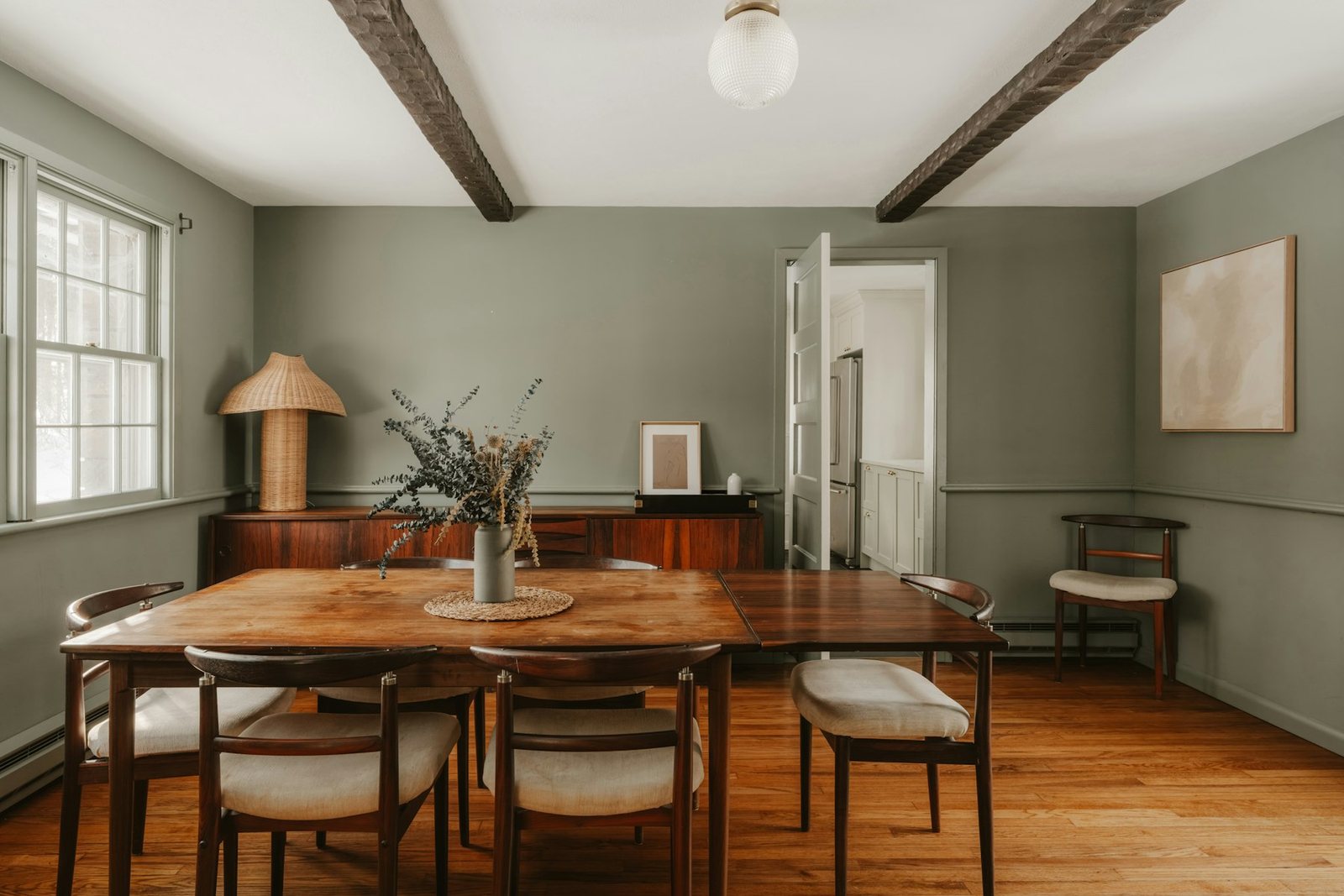
Matching every piece of wood in a room, floor, table, chairs, shelves, rarely looks as good as it sounds. Rooms with a single wood tone can feel flat or like a showroom set. Mixing woods adds depth and a sense that the room was collected over time. The challenge is mixing them so they look intentional rather than accidental.
Key takeaways
- Read the undertones, just as you would with paint.
- Choose clear contrast or a very close match; avoid tones that are almost, but not quite, the same.
- Repeat each wood in at least two places so it looks planned.
- Vary grain and scale carefully; several busy grains together can feel restless.
- Use rugs and textiles between wood floors and wood furniture.
Reading wood: undertone, value and grain
Undertone
Wood has undertones much like paint colors:
- Red or orange: cherry, many mahogany finishes, some stained oak and pine.
- Yellow: many natural or clear-finished oak, pine and maple pieces, especially as they age.
- Neutral or grey: whitewashed, limed or weathered finishes, and some walnut and ash.
Place pieces side by side, or compare them against a white sheet, to see undertones clearly. Our guide to paint color undertones uses the same approach for walls.
Value
Value is how light or dark the wood is. Mixing light and dark woods creates contrast; mixing mid-tones that are close together often looks like a failed attempt to match.
Grain
Grain patterns range from bold (oak, ash, many reclaimed woods) to fine and calm (maple, cherry, birch). One bold grain with calmer companions usually works better than several strong grains competing.
Choosing a dominant tone
Pick one wood to lead the room. Often it is the floor, because it covers the most area, but it could be a large piece such as built-in cabinetry. Then add one or two supporting tones. A common rule of thumb is to keep to around two or three wood tones in a room so it feels layered but not chaotic.
Contrast or close match?
| Approach | How it works | Watch for |
|---|---|---|
| Strong contrast | Light floor with dark furniture, or the reverse | Balance dark pieces around the room so one side does not feel heavy |
| Close match | Same species and finish, or nearly | Near misses: almost-matching woods can look like mistakes |
| Shared undertone | Different values with the same undertone | Can feel harmonious even with strong value contrast |
| Contrasting undertone | Warm and cool woods together | Works best when repeated and bridged by other materials |
Repeat and distribute
A single walnut side table in a room of oak can look out of place. Two or three walnut accents, such as a picture frame, a stool and a shelf, spread around the room, make the mix look deliberate. Distribute darker woods so the visual weight is balanced.
Use buffers
When wood furniture sits on a wood floor of a different tone, a rug between them separates the two and stops them competing. Textiles, upholstered pieces and painted furniture break up large areas of wood. See our rug size guide for sizing rugs under furniture.
Finishes and sheen
Sheen affects how woods relate. A high-gloss table next to a matte oiled floor can look disconnected even if the colors work. Keeping sheens in a similar range, mostly matte or satin, is an easy way to make different woods feel related.
Room by room
Living room
A mid-tone oak floor works with darker walnut furniture and a lighter accent such as a woven or cane chair. See woven chairs explained. A rug under the seating separates floor and furniture. For layout, see small living room layout ideas.
Kitchen
Kitchens often combine wood floors, wood cabinets or open shelving, cutting boards and wooden stools. Pick the cabinets or the floor as the lead tone and make the other clearly different. Open shelves or a wood countertop can repeat a third tone. See open shelving vs upper cabinets and our guide to caring for wooden kitchenware.
Dining room
A dining table is usually the largest piece of wood furniture in the room. If it is close in tone to the floor, a rug or contrasting chairs help it stand apart. Our dining table size guide covers rug and chair clearances.
Bedroom
Bedside tables do not need to match the bed. Pairing a light wood bed with darker bedside tables, repeated in a mirror frame or lamp base, keeps the room calm and layered.
Reclaimed and painted wood
Reclaimed wood brings strong character, variation and often warmer, older tones. Pair it with calmer woods and plain surfaces so it remains the focus. See our guide to reclaimed wood interiors. Painted furniture is a useful way to add a piece without adding another wood tone. For styles built on natural wood, see Japandi vs Scandinavian style.
Common mistakes
- Trying to match every piece exactly.
- Two or three woods that are almost the same color.
- One wood tone that appears only once in the room.
- Too many bold grains together.
- Wood furniture directly on a similar but not matching wood floor, with nothing between them.
Bottom line
Choose a lead wood, add one or two clearly different companions, repeat each tone around the room, keep sheens related, and use rugs and textiles to separate woods that touch. The result looks layered and collected rather than mismatched.