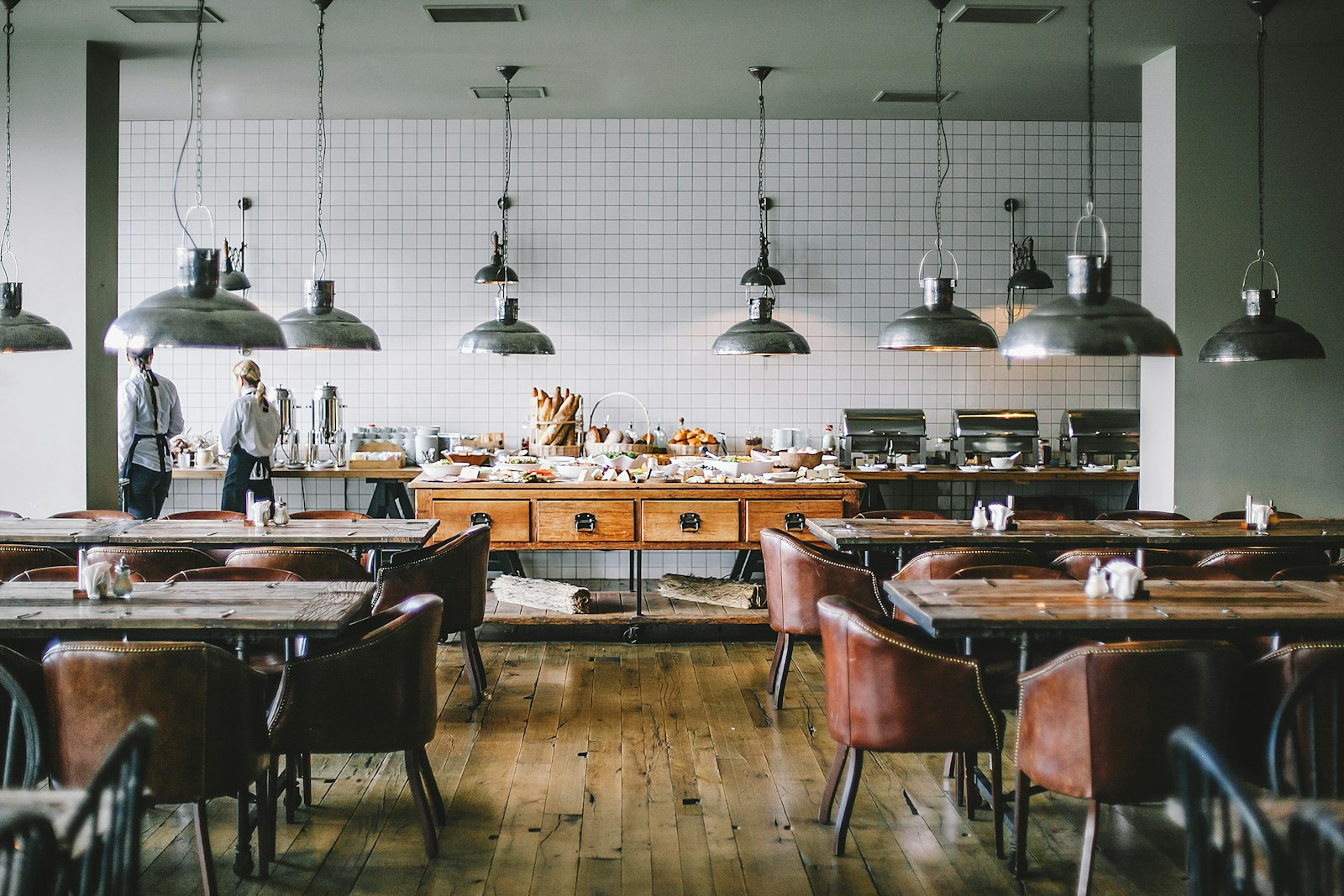
Enamel dome pendants over a long communal table, cage lights on exposed conduit, a row of bare filament bulbs above the bar: industrial lighting has been a restaurant staple for years because it is honest, sturdy and warm. It is also easy to get wrong. Bare bulbs at eye level dazzle guests, a ceiling of identical pendants can leave faces in shadow, and a cheap dimmer can make the whole room flicker at dinner service.
This guide is about getting the look and the light at the same time.
Key takeaways
- Decorative fixtures are rarely enough on their own. Pair them with discreet ambient and task lighting.
- Keep bare bulbs out of sightlines or use low-output, dimmable filament LEDs and shaded fixtures.
- Choose one warm color temperature for the dining room and stick to it.
- Look for high color rendering so food and faces look natural.
- Test dimming before you buy in bulk. LED and dimmer compatibility is the most common source of flicker and buzz.
- Check health and energy codes for the kitchen, food display and overall lighting power.
The industrial vocabulary
The look draws on factories, warehouses and workshops. Common pieces include:
- Metal or enamel dome pendants, often in black, white, green or raw metal, with a white enamel interior that reflects light downward.
- Cage lights, a bulb protected by a wire guard, originally made for workshops and ships.
- Prismatic glass pendants, the ribbed glass shades seen in old factories and schools, which spread light softly.
- Exposed filament bulbs, now mostly LED versions of the old carbon-filament look.
- Swing-arm wall lights and articulated lamps.
- Exposed conduit and track, treated as part of the design.
Choose one or two of these and repeat them. A room that uses every industrial trope at once looks like a theme rather than a place.
Layer the light
Good restaurant lighting combines four kinds of light:
- Ambient light fills the room so people can move safely and see each other. In industrial interiors this is often indirect: uplight bounced off a ceiling, or discreet downlights between the decorative pendants.
- Task light goes where work happens: the pass, the bar back, the host stand, the coffee station and the point of sale. Staff need clear, glare-free light to work quickly and safely.
- Accent light picks out shelves of bottles, a mural, textured walls (reclaimed wood and brick come alive under grazing light) or a display counter.
- Decorative light is the visible fixtures that set the style. They add sparkle and character but should not be expected to light the whole room.
When the decorative pendants are the only light source, designers end up making them too bright, which is where glare comes from.
Color temperature
Color temperature, measured in kelvin (K), describes how warm or cool white light looks.
| Color temperature | Feel | Typical use |
|---|---|---|
| 2200K to 2400K | Very warm, candle-like amber | Bars and evening dining, decorative filament bulbs |
| 2700K | Warm white | Most dining rooms and cafes |
| 3000K | Warm-neutral | Bright daytime cafes, bakeries, counters |
| 3500K to 4000K | Neutral | Back-of-house and kitchen task areas |
Pick one temperature for each space and keep it consistent across fixtures; a mix of warm pendants and cooler downlights looks patchy and makes food look odd. Dim-to-warm LEDs, which become warmer as they dim, imitate the behavior of old incandescent bulbs and suit restaurants that change mood through the evening.
Color rendering
Color Rendering Index (CRI) indicates how naturally a light source shows colors compared with a reference. For dining rooms, open kitchens and food displays, a CRI of 90 or higher is a common recommendation. If the specification sheet lists R9, the value for saturated red, a higher number helps meat, tomatoes, berries and skin tones look right.
Glare and bare bulbs
Glare happens when a bright source sits in someone’s field of view. Industrial schemes are prone to it because of bare bulbs and shiny metal shades. To avoid it:
- Keep bare bulbs above eye level or behind a shade, and do not hang them where seated guests look straight into them.
- Use low-output filament LEDs for decorative bulbs and add separate ambient light.
- Choose deeper shades that hide the bulb from normal viewing angles, or shades with diffusers.
- Dim decorative fixtures in the evening while keeping task areas bright enough.
- Check reflections in mirrors, glazing and glossy tabletops.
Pendant height and spacing
For pendants over dining tables, a common rule of thumb in the US is to hang the bottom of the fixture roughly 30 to 36 inches above the tabletop, adjusting for ceiling height, shade size and sightlines. Lower pendants feel more intimate; higher ones keep views across the room open.
- Size to the table. A frequently used guideline is a single pendant around one half to two thirds of the table’s width, or several smaller pendants spaced evenly along a long table.
- Plan the furniture layout first. Pendants fix tables in place; a room that regularly rearranges for groups may suit track lighting or a regular grid better.
- Bar counters usually take a row of smaller pendants, kept high enough not to block bartenders’ sightlines.
Dimming
Most restaurants want to dim through the day, and LEDs make this trickier than it used to be:
- Match dimmers to drivers. LED products are designed for particular dimming methods, such as forward-phase (TRIAC), reverse-phase (ELV) or 0-10V control. Mismatches cause flicker, buzzing or a sudden drop-off at low levels.
- Check the low end. Ask how low the fixture dims smoothly; a dinner setting at a few percent needs a product designed for it.
- Test a sample with the actual dimmer before ordering dozens of fixtures.
- Use scenes on a simple control panel (breakfast, lunch, dinner, cleaning) so staff do not set levels by guesswork.
Code points near food
In the US, most states adopt some version of the FDA Food Code, which sets minimum light levels for food areas. Typical requirements are at least 50 foot-candles (about 540 lux) where staff prepare food or work with knives and equipment, at least 20 foot-candles (about 215 lux) at handwashing and warewashing areas and some display areas, and at least 10 foot-candles (about 108 lux) in walk-in coolers and dry storage. The Food Code also requires lamps over exposed food, clean equipment and utensils to be shielded, coated or otherwise shatter-resistant. That matters for decorative bare bulbs over an open kitchen or a pastry case. Check your local health department’s version, as details vary.
Commercial energy codes in many jurisdictions also limit total lighting power and require controls such as automatic shutoff. Emergency lighting and exit signs are separate life-safety requirements. Your electrician or lighting designer should confirm all of these early, because they affect fixture choices and wiring.
Maintenance
- Plan access. Fixtures over banquettes or high ceilings need a safe way to clean and relamp them.
- Expect dust and grease. Cages, open shades and fixtures near the kitchen collect both; choose finishes that can be wiped.
- Buy spares. LED color can vary between production batches, so keep spare lamps from the same order.
- Keep a lamp schedule listing each fixture, lamp type, color temperature and dimmer, so replacements match.
Common mistakes
- Using decorative bulbs as the only light, then turning them up until they glare.
- Mixing color temperatures across pendants, downlights and signage.
- Forgetting task light at the pass, bar and register.
- Ignoring dimmer compatibility until opening week.
- Hanging pendants before the furniture plan is final.
- Bare bulbs over food without shatter-resistant lamps.
Bottom line
Industrial lighting works when it is part of a layered plan: decorative fixtures for character, quieter ambient and task light for function, one consistent warm color temperature, high color rendering and dimming that has been tested. Settle the code points for kitchens and food displays early. For the rest of the room, our guides to restaurant interior design, acoustic felt panels and reclaimed wood in interiors cover materials that often share a ceiling with these lights.