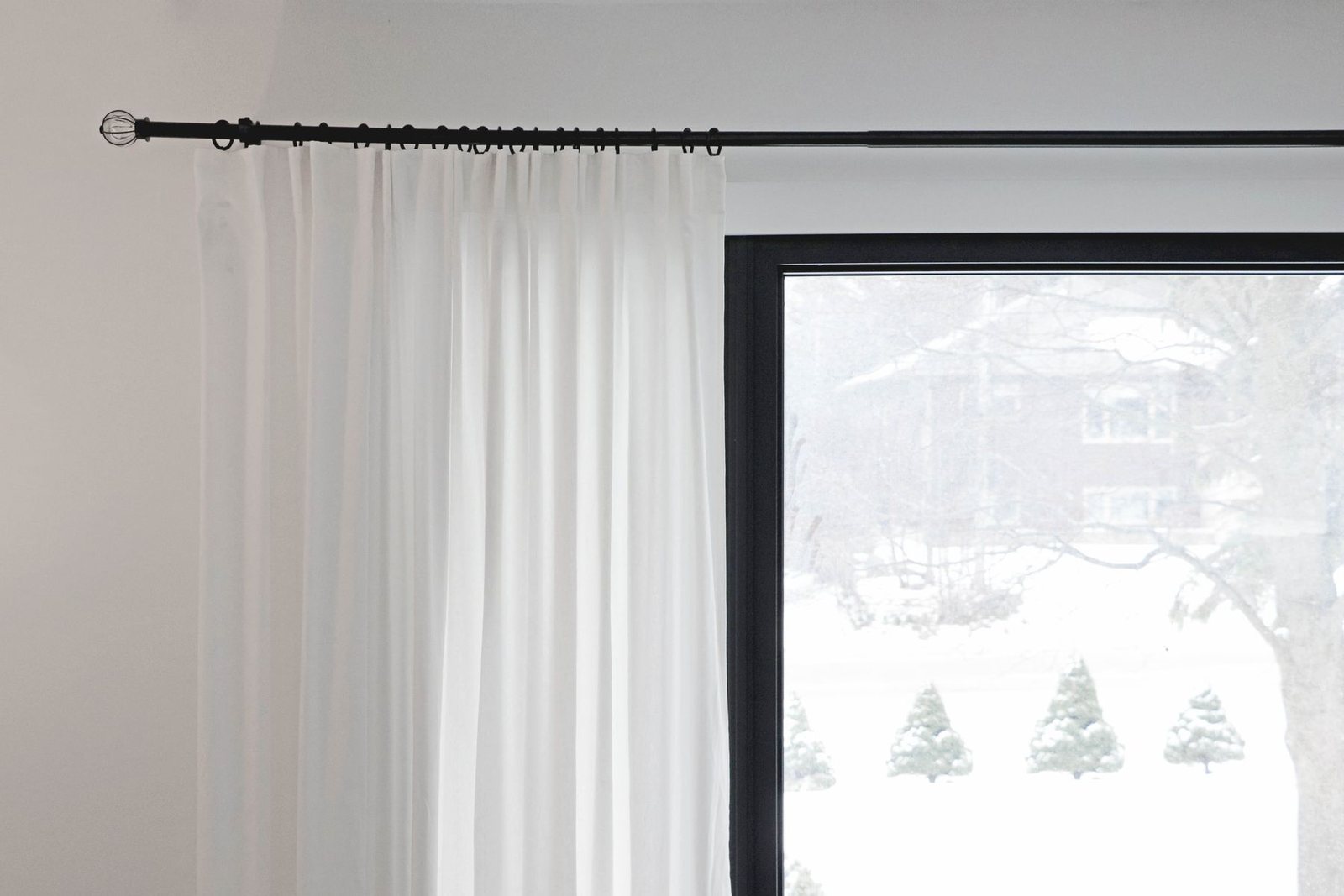
Curtains change a room more than their cost suggests. Hung well, they make windows look taller and wider, soften hard surfaces and frame the view. Hung badly, too low, too narrow or too short, they make even a good room look unfinished.
Most of the difference comes from a few measurements. This guide gives the common rules of thumb and the decisions behind them.
Key takeaways
- Higher and wider makes windows look bigger and lets in more light.
- Measure from the rod, not the window, when choosing curtain length.
- Fullness decides whether curtains look generous or skimpy.
- Hardware matters: sturdy brackets and anchors keep rods straight and safe.
Rod height
A common rule of thumb is to mount the rod at least 4 to 6 inches above the window frame. In many rooms, mounting it higher, roughly halfway between the top of the frame and the ceiling or just below the crown molding, makes the window and the ceiling look taller.
Exceptions:
- Very little space above the window: mount just below the ceiling.
- Interrupting features, such as beams or vents, may set the limit.
- Consistency: in a room with several windows of different heights, align rods at one height so the room looks orderly.
Rod width
Extend the rod beyond the window frame on each side so that, when open, the curtains stack on the wall rather than covering the glass. A common starting point is 8 to 12 inches on each side; heavier or fuller curtains stack wider and may need more.
For a pair of windows close together, one long rod across both often looks better than two short ones.
Curtain length
Measure from the point where the curtain hangs (the rod, rings or hooks) to the floor, then choose a finish:
| Style | Description | Feel |
|---|---|---|
| Floating | About half an inch above the floor | Clean and practical; easy to clean around |
| Kissing | Just touching the floor | Tailored, finished |
| Break | One to two inches extra, folding slightly on the floor | Relaxed, soft |
| Puddle | Several inches pooling on the floor | Romantic, formal; collects dust; not for busy areas |
Avoid curtains that stop short of the floor in living rooms and bedrooms unless they are deliberately short, such as café curtains or sill-length panels over a radiator or a window seat.
Check whether the curtain length listed by the maker includes the header, rings or tabs, and allow for shrinkage if the fabric will be washed.
Fullness
Fullness is the total width of the curtain fabric compared to the width it covers when closed.
- About 1.5 times: a lighter, flatter look; common with grommet curtains.
- About 2 times: a common standard for a full look.
- About 2.5 times or more: very full, luxurious; suits sheers and pinch pleats.
Measure the rod length between the brackets and multiply by your fullness to find the total width of panels you need.
Header styles
| Header | Look | Notes |
|---|---|---|
| Rod pocket | Gathered, casual | Harder to open and close often |
| Grommet (eyelet) | Deep, regular folds | Slides easily; modern look |
| Back tab | Tailored folds, rod hidden | Good for stationary panels |
| Tab top | Casual | Visible tabs |
| Pinch pleat | Formal, structured | Usually with rings or a track |
| Ripplefold or wave | Soft, even waves | Needs a track system |
Linings and fabrics
- Lined curtains hang better, protect the fabric from sun and add insulation.
- Blackout linings suit bedrooms and media rooms.
- Sheers filter light and add privacy by day; layering sheers with heavier curtains on a double rod gives flexibility.
- Natural fabrics such as linen and cotton look relaxed and may wrinkle; synthetics and blends resist fading and creasing.
Hardware
- Rods: choose a diameter that will not sag over the span, and add center supports for long rods.
- Brackets: place them close to the rod ends and add a center bracket on wide windows.
- Anchors: use suitable wall anchors for drywall or plaster, or find studs. Heavy curtains need solid fixing.
- Tracks: ceiling- or wall-mounted tracks suit bay windows and ripplefold curtains.
- Return or wraparound rods block light at the sides and suit blackout setups.
Measuring and installing
- Decide the rod height and width and mark the bracket positions with a pencil and level.
- Check that the rod will clear window handles, trim and any radiators.
- Fix brackets securely into studs or with appropriate anchors.
- Hang the rod and check it is level.
- Hang the curtains and dress them: open and close them a few times, arranging the folds evenly, and leave them tied loosely for a day or two to train the folds.
- Steam out creases.
Practical points
- Radiators and heaters: keep fabric away from heat sources as manufacturers require; shorter curtains or blinds may be safer over radiators.
- Cords and chains: choose cordless or safety-compliant window coverings in homes with children.
- Renters: tension rods, adhesive hooks rated for the weight, or existing fixtures avoid drilling; check with your landlord before drilling. See renter-friendly decor.
Curtains in the wider room
Curtains, rugs and lighting work together. Our rug size guide and small living room layout ideas cover the rest of the room, and layered lighting at home explains how window treatments affect light day and night.
Common mistakes
- Mounting the rod just above the frame on a tall wall.
- A rod that ends at the frame, so open curtains cover the glass.
- Curtains a few inches too short.
- Too little fullness, so closed curtains look stretched.
- Weak fixings that let the rod sag.
FAQ
Should curtains touch the floor? In most living rooms and bedrooms, yes, or nearly. Floating just above the floor is practical in busy areas; puddling suits formal rooms.
How wide should curtains be? Aim for a total width of about 1.5 to 2.5 times the rod length between brackets, depending on the header and the look you want.
Can I hang curtains on a window with blinds? Yes. Mount the rod above and outside the window frame so curtains clear the blinds, and use deeper brackets if needed.